 NVIDIA
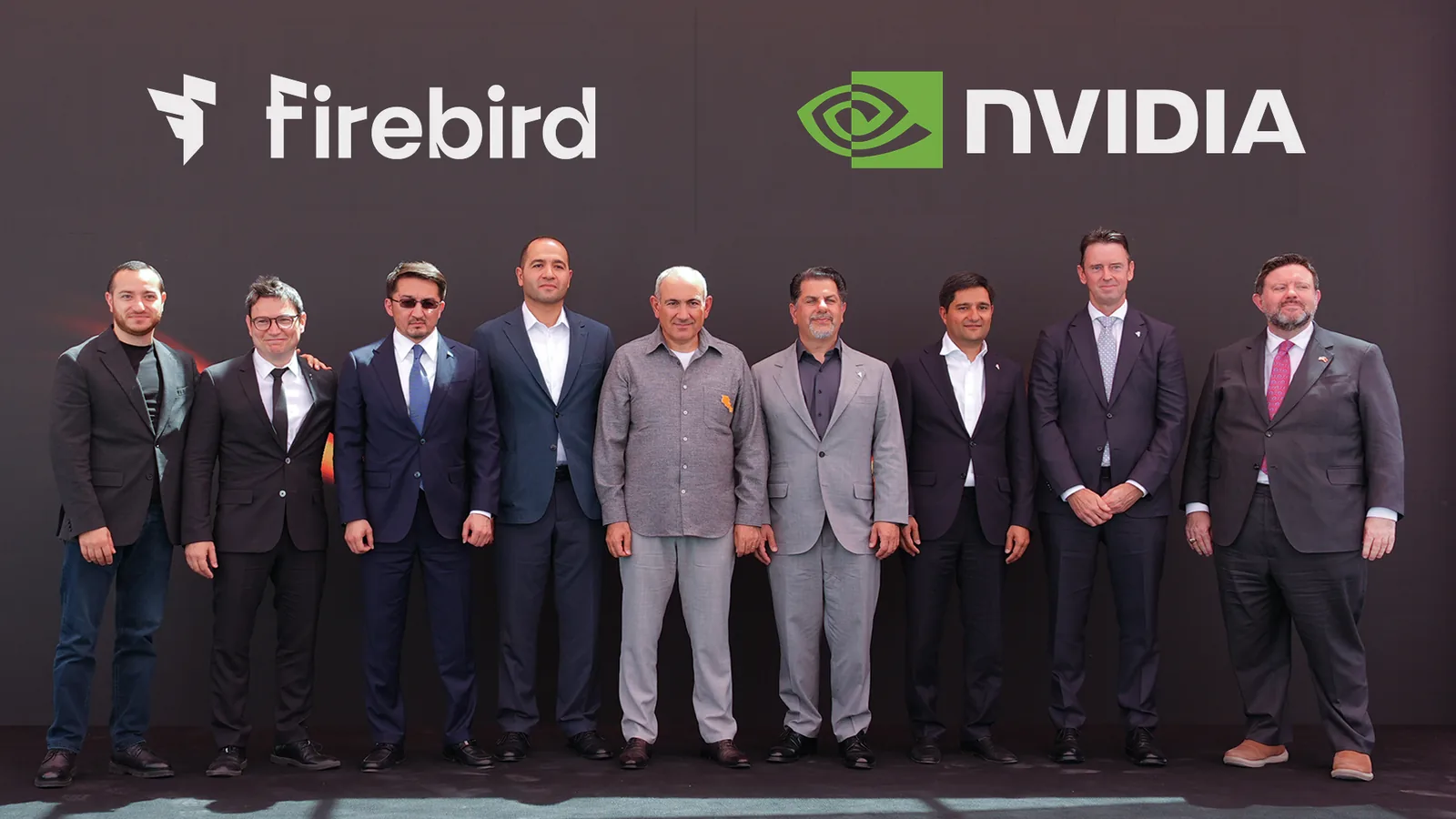
Firebird opened the CIS region's largest AI factory in Armenia, according to NVIDIA. The opening ceremony included Armenia's prime minister Nikol Pashinyan, Kazakhstan's deputy prime minister Zhaslan Madiyev, and the U.S. chargé d'affaires David Allen. The facility uses NVIDIA accelerated computing and Dell high-performance AI infrastructure, with Dell PowerEdge servers as part of NVIDIA's total AI factory platform.
Scale and Power Plans
Firebird plans to install more than 70,000 NVIDIA Rubin and Blackwell GPUs in Armenia by the end of 2027. The site's planned power capacity is 300 megawatts by that same date. Firebird co-founder Alexander Yesayan said the company aims for roughly 2 gigawatts of AI capacity worldwide within about two years. NVIDIA also stated that Firebird's roadmap targets about 2 gigawatts of AI infrastructure across Armenia, Kazakhstan, and other markets.
The Armenian AI factory was delivered in just over six months. NVIDIA's DSX platform allows the factory to run up to 40 percent more GPUs in the same footprint, which is a key factor for inference workloads that often require dense compute and efficient power usage.
Infrastructure and Customers
Schneider Electric supplies medium- and low-voltage switchgear, three-phase UPS systems, and rack enclosures for the power infrastructure. Vertiv provides chilled-water cooling, TrimCooler technology, and iCOM CWM manager for thermal management. These components are critical for maintaining performance and reliability in high-density GPU deployments.
Early customers include Perplexity, which will use the infrastructure for its AI agent platform and answer engine. NVIDIA announced its intent to invest in Firebird following an earlier CoreWeave investment earlier this year.
For inference engineers, the scale of this deployment signals a shift toward large, centralized AI factories that can serve multiple customers. The use of Rubin and Blackwell GPUs, combined with DSX's density improvements, means that inference workloads can be served with higher throughput per square foot. The power and cooling infrastructure from Schneider Electric and Vertiv addresses the operational challenges of running tens of thousands of GPUs continuously.
The timeline of six months from delivery to operation is notable, suggesting that standardized platforms and pre-integrated infrastructure can accelerate deployment. As more AI factories come online, the availability of compute for inference tasks will increase, potentially affecting pricing and latency for model serving.
Firebird's expansion into Kazakhstan and other markets, along with the 2-gigawatt target, indicates a broader regional strategy. For builders of open-weight models, this means more options for hosting and serving large models without relying solely on hyperscalers. The involvement of Perplexity as an early customer shows that AI agent platforms require substantial inference capacity, which these factories aim to provide.
The combination of NVIDIA's compute platform, Dell's servers, and specialized power and cooling from Schneider Electric and Vertiv creates a reference architecture for large-scale AI infrastructure. This could serve as a model for other regions looking to build similar capabilities, especially where power and cooling are constrained.
Overall, the Firebird factory in Armenia represents a significant addition to global AI compute capacity, with a focus on serving inference workloads at scale. The planned GPU count and power capacity, along with the density improvements from DSX, position it as a major player in the CIS region and beyond.
Sources & references
NVIDIA: Firebird Launches CIS Region’s Largest AI Factory in Armenia ↗Source consulted: 2026-10-15


