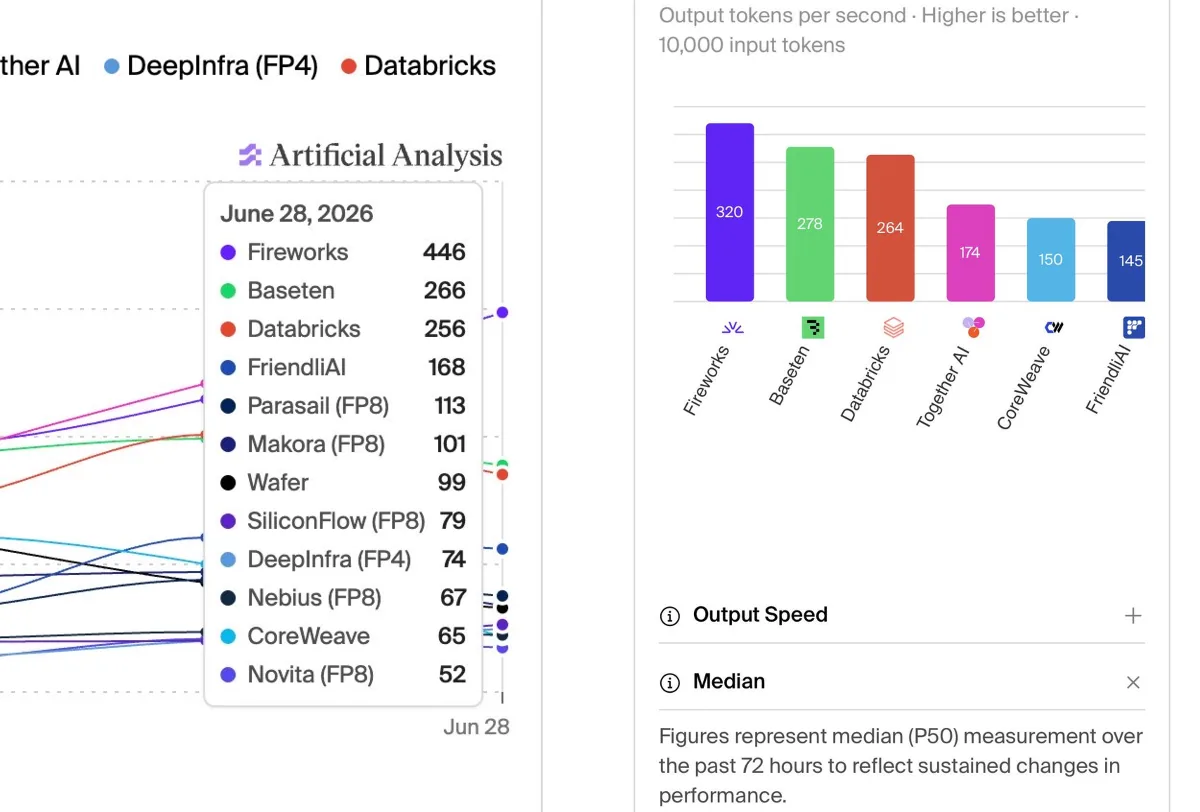
Fireworks AI launched GLM 5.2 Fast on June 30, 2026, a serverless serving path for the GLM 5.2 model that runs about 2x faster than the company's Standard route on the same workload. The Fast path uses the same weights and quality as Standard, and it runs on shared infrastructure without reserved GPUs. Fireworks reported a peak of 446 tokens per second on Artificial Analysis and said it is consistently ranked as the fastest provider on OpenRouter for this model.
The release targets coding-agent workloads, where prompts average around 90,000 tokens on Fireworks public endpoints. The company says speed determines whether an agent feels usable, whether retries become expensive, and whether long context stays practical. Factory's Droid coding agent already offers GLM 5.2 hosted on Fireworks.
Serving surface and pricing
GLM 5.2 Fast includes the full 1M-token context window, high adaptive rate limits with no upfront commitment, OpenAI- and Anthropic-compatible APIs, and availability on Serverless Priority for stronger admission under congestion. Dedicated deployments remain an option for workload-specific tuning.
Prompt caching is priced at $0.14 per 1M cached input tokens, a 90% discount from fresh input at $1.40 per 1M. Fireworks uses a multi-tier cache with hot KV state near the GPUs and colder long-lived state in lower-cost tiers, so repeated context stays cheap without pinning every cache in scarce HBM. For a typical 90k prompt with 600 turns and 500 output tokens, the company says the vast majority of tokens will be cached. Rate limits on cached tokens are higher than on fresh input.
Fast pricing is $2.10 per 1M input tokens, $0.21 per 1M cached input tokens, and $6.60 per 1M output tokens. Standard is $1.40 input, $0.14 cached, and $4.40 output. Adding Priority raises prices to $1.75 input, $0.18 cached, and $5.50 output on supported tiers.
Architecture split
GLM 5.2 presents two serving problems: a large mixture-of-experts MLP stack and a sparse MLA attention stack. Around 98% of the model's parameters live in expert weights, but each token activates only a small subset. Expert parallelism spreads experts across GPUs, lowering per-GPU weight residency and freeing HBM for KV cache, batching, and long contexts. But sharding adds all-to-all communication, and tensor parallelism adds an all-reduce on every layer. Load balance matters because hot experts with idle neighbors hurt utilization. The company describes the tradeoff as U-shaped: more sharding helps until narrower GEMMs, communication, and imbalance dominate.
The attention side uses DeepSeek Sparse Attention with an addition called IndexShare, where a single indexer serves a group of layers. Each token runs a cheap indexer over the context, selects the most relevant 2,048 prior tokens, and runs expensive attention only on those. The dominant attention path is bounded by the fixed top-k rather than raw sequence length, though the indexer still scans the context and cache movement still matters.
The main attention is MLA, which stores compressed latent KV shared across heads rather than per-head keys and values. Naive tensor-parallel attention tends to replicate the same latent KV across ranks, burning capacity. For many decode-heavy workloads, Fireworks uses data-parallel attention, sharding across requests so each request's KV stays local. Expert sharding and attention sharding are chosen independently, sometimes across different hardware domains.
Fireworks also uses lower-precision serving only where quality evals hold, speculative decoding tuned to GLM 5.2, and separate prefill and decode phases so long agent prefixes do not compete with generation every turn. The company says it ran the same eval suite on Standard and Fast before launch and required them to match on tool-call validity, JSON-schema adherence, and long-context behavior. On SWE-bench Verified, GLM 5.2 scored 81.8% on Fireworks GPUs.
Fast is enabled by switching the model ID to accounts/fireworks/routers/glm-5p2-fast, and Priority is added with a service tier option at a slightly higher price. Fast increases token generation speed; Priority improves reliability by giving requests precedence over Standard traffic when the fleet is saturated.
Sources & references
Fireworks AI: GLM 5.2 Fast is live on Fireworks ↗Source consulted: 2026-10-15

 NVIDIA

