 NVIDIA
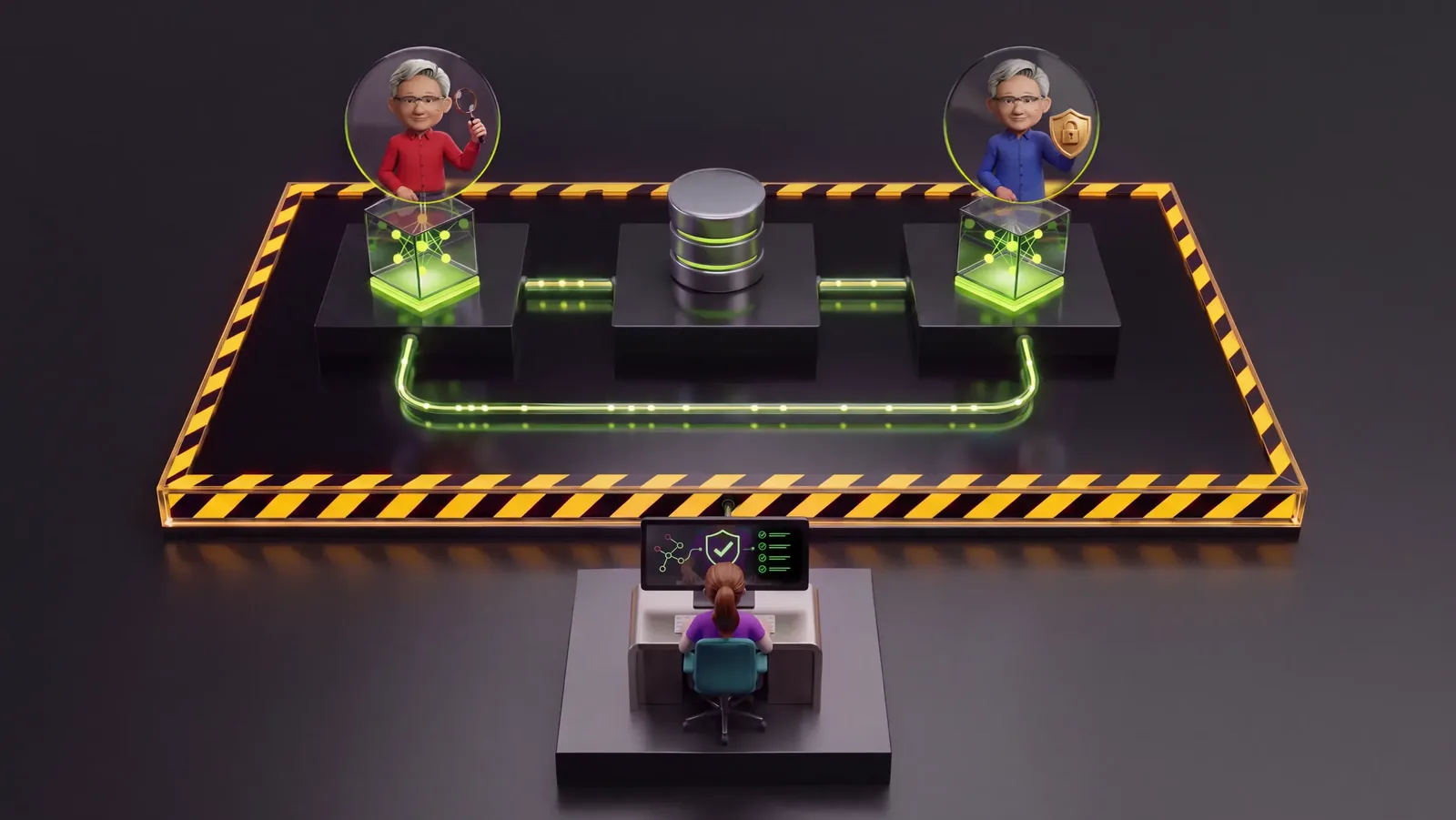
NVIDIA and CrowdStrike evaluated an agentic attack-defense system in an isolated environment modeled on NVIDIA accelerated computing infrastructure. The defensive harness combined six mechanisms: a schema knowledge base, telemetry grounding, specialized detection authoring, artifact linting, detection replay, and independent review. Nemotron 3 Ultra handled defensive orchestration, while a post-trained Nemotron 3 Super acted as a bounded expert for detection generation and repair. Training used NVIDIA NeMo Gym and NVIDIA NeMo RL for reinforcement learning with verifiable rewards.
Measured Outcomes
Backtesting produced a 41.9% mean detection rate across six sessions, a 2.5x improvement over the default harness using Nemotron 3 Ultra alone. In live-fire testing against eight unseen attacks, open-model detections generalized at 45%, compared with 29% for the frontier system. Three open-model detections qualified as gold and covered all eight attacks, while the frontier system achieved no gold detections. CrowdStrike reports its Blue Solano defensive model is more accurate than the leading proprietary frontier model, at 99% lower cost in internal evaluations.
Training and Validation Details
Fine-tuning of Nemotron 3 Super used 9,349 detection-generation and repair examples spanning 59 programmatically generated error types. The reinforcement-learning reward was based on F1 overlap between generated and reference query results. Invalid queries received up to five repair attempts, and unresolved attempts received zero reward. Artifact linting rejected detections that referenced specific IP addresses, hosts, users, or subnets. Independent review judged each detection for behavioral alignment, robustness, and appropriate multi-signal use.
Closed-Loop Workflow
The closed-loop workflow consists of four stages: execute and capture, process and reconstruct, generate and validate, and retest, adapt, repeat. A representative test environment was built from a sanitized natural-language specification of NVIDIA accelerated computing infrastructure. The loop continues until no viable attack path remains within the modeled environment. The Open Secure AI Alliance is expanding the ecosystem of open models, harnesses, and tools for cybersecurity. Next steps include exploring NVIDIA Nemotron 3 for specialized agents, reviewing NeMo Megatron Bridge, trying NeMo Gym, and using NeMo RL.
Sources & references
NVIDIA: Building an Adaptive Agentic Cybersecurity System with NVIDIA Nemotron ↗Source consulted: 2026-10-15


