 NVIDIA
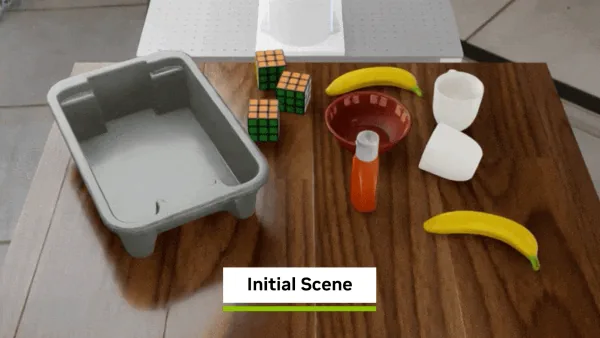
NVIDIA introduced Cosmos 3, an open omni-model world foundation model, and showed how post-training turns it into robot policies called world action models (WAMs). The company published the details on August 4, 2026, along with two policy checkpoints, Cosmos3-Nano-Policy-DROID and Cosmos3-Edge-Policy-DROID, both post-trained for the DROID platform, a Franka Panda arm with a Robotiq gripper.
What a WAM changes
A WAM replaces the vision-language backbone of a vision-language-action (VLA) model with a video world model. NVIDIA's research paper, World Action Models are Zero-shot Policies, argues that jointly predicting video and action gives policies properties a VLA lacks. A WAM learns from diverse interaction data because any physical interaction teaches it something, while a VLA often needs near-identical demonstrations of the same task. Physics generalizes better than semantics, so a model that learned dynamics carries that knowledge into unseen scenes and motions. It also adapts to new robot embodiments with fewer demonstrations, since the model already understands physical interaction.
Cosmos 3 as a foundation
Cosmos 3 uses a Mixture-of-Transformers architecture. Multimodal input flows through an autoregressive transformer for reasoning, producing discrete tokens like text, which guides a diffusion transformer for continuous modalities including image, video, audio, and action. Text is generated by next-token decoding; everything else, including actions, is synthesized through iterative denoising. The model comes in three sizes: 4B Edge, 16B Nano, and 64B Super.
The training data includes roughly 767 million images, 348 million videos of real-world dynamics, and 8 million action samples spanning robot manipulation, autonomous driving, camera motion, and egocentric motion. NVIDIA reports that the omni checkpoint raised RoboLab success from 28.1% to 36.8% compared to a base checkpoint trained with the same recipe, data, and compute, evidence that the improvement comes from the architecture.
Deployment options
The 16B Nano policy runs on a workstation, served on a single NVIDIA RTX PRO 6000, with the robot streaming observations over the network and receiving action chunks back. The 4B Edge policy runs on-device, operating at 640x360 resolution and generating 32 actions per inference on Jetson Thor at 15 Hz control frequency. It is supported across NVIDIA edge computers including RTX PRO GPUs, DGX, GeForce RTX GPUs, and Jetson, including the new Jetson T2000 and T3000 modules.
The policy retains the full omni architecture, so it can still reason and generate video, not just output joint positions. When the model outputs actions, it can also output a video of what the robot's cameras will see if those actions are executed. NVIDIA released the base model, datasets, post-training recipe, trained weights, evaluation tools, and serving stack under a license that permits commercial use. Teams can convert their data to the LeRobotDataset format and run the published recipe to post-train their own policies.
Sources & references
NVIDIA: Beyond VLAs: How World Action Models Reshape Robot Manipulation ↗Source consulted: 2026-10-15


