 NVIDIA
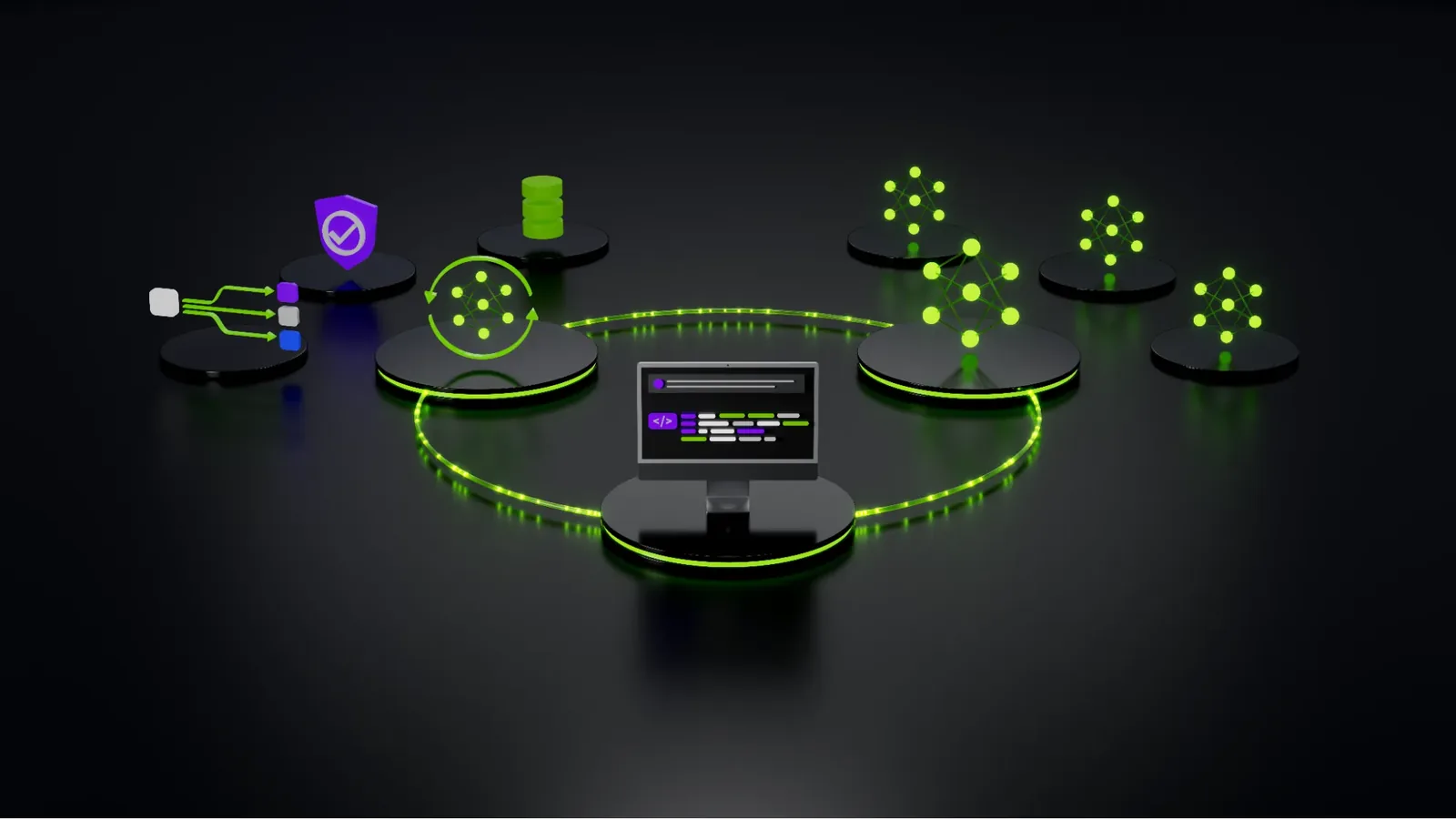
NVIDIA published a guide on mastering agentic techniques through reinforcement learning with verifiable rewards (RLVR), a method that uses group relative policy optimization (GRPO) to specialize open models for domain-specific agents. The workflow starts with a clear task, a trustworthy verifier, and a small baseline model. It then iterates through supervised fine-tuning if needed, GRPO training, and held-out evaluation. NVIDIA positions this as a practical path for developers who need agents that perform reliably in specific environments, such as tool calling or project management.
The RLVR Core
GRPO generates multiple completions per prompt, scores them with a verifier, and updates the model based on relative performance within the group. This contrasts with token-level optimization, and NVIDIA notes that extensions like dynamic sampling policy optimization (DAPO) add dynamic sampling and asymmetric clipping for better exploration, while group sequence policy optimization (GSPO) optimizes at the sequence level to improve stability for Mixture-of-Experts models. Reward design can start with a binary signal, +1 for passing the verifier and 0 otherwise, then be refined with intermediate signals. Reward functions should measure the real task, be hard to game, and fail visibly when wrong. Before training, NVIDIA recommends running the reward function on 50 to 100 model outputs and manually inspecting the scores.
For verifiable tool-use tasks, the recommended path is supervised fine-tuning if demonstrations exist, then GRPO with verifiable rewards, evaluation, and iteration. SFT is used when demonstrations of desired behavior are available, DPO when preference pairs exist, RLHF for nuanced human preferences, and RLVR for algorithmically checkable correctness. Production failures can be turned into regression tests, bucketed by failure mode, and fixed with the lightest intervention, from prompt changes to SFT, DPO, or RLVR. Tuned checkpoints are versioned to enable safe rollback of agent models.
Tooling and Costs
NVIDIA NeMo RL and NeMo Gym provide scalable post-training workflows and environment infrastructure for reproducible RL runs. NeMo Gym connects agents, models, external tools, and verifiers to build scalable, reproducible RL environments. NeMo Data Designer can generate structured task datasets, control field relationships, batch generate, and validate outputs against specifications. The Nemotron repository contains open models, recipes, and agentic AI examples, and the NeMo RL getting-started example demonstrates a minimal RL setup. A Workplace Assistant tutorial trains Nemotron Nano 9B v2 with GRPO for tool-calling in project-management workflows.
Costs are explicit: rollout cost scales with the number of tool calls, conversation turns, and environment steps, and inference engines like vLLM reduce latency. Training cost scales with dataset size and the number of policy updates, and Megatron and NeMo Automodel improve throughput. Small adapter-based experiments, around 1B to 8B parameters, can run on a single modern GPU, while larger models need multi-GPU nodes. When compute is limited, NVIDIA advises reducing model size, max tokens, generations per prompt, and parallel environments first.
NVIDIA cites OpenAI's o-series models as trained with large-scale RL, and DeepSeek-R1 as showing GRPO and verifiable rewards improve math, code, and reasoning. Nemotron 3 Super was post-trained with multi-environment RL across 21 NeMo Gym verifiers and 37 datasets, producing about 1.2 million environment rollouts. These examples illustrate the scale possible with the workflow, but the guide focuses on practical steps for developers who want to apply RLVR to their own agent tasks without necessarily reaching that scale.
Sources & references
NVIDIA: Mastering Agentic Techniques: AI Agent Reinforcement Learning ↗Source consulted: 2026-10-15


