 NVIDIA
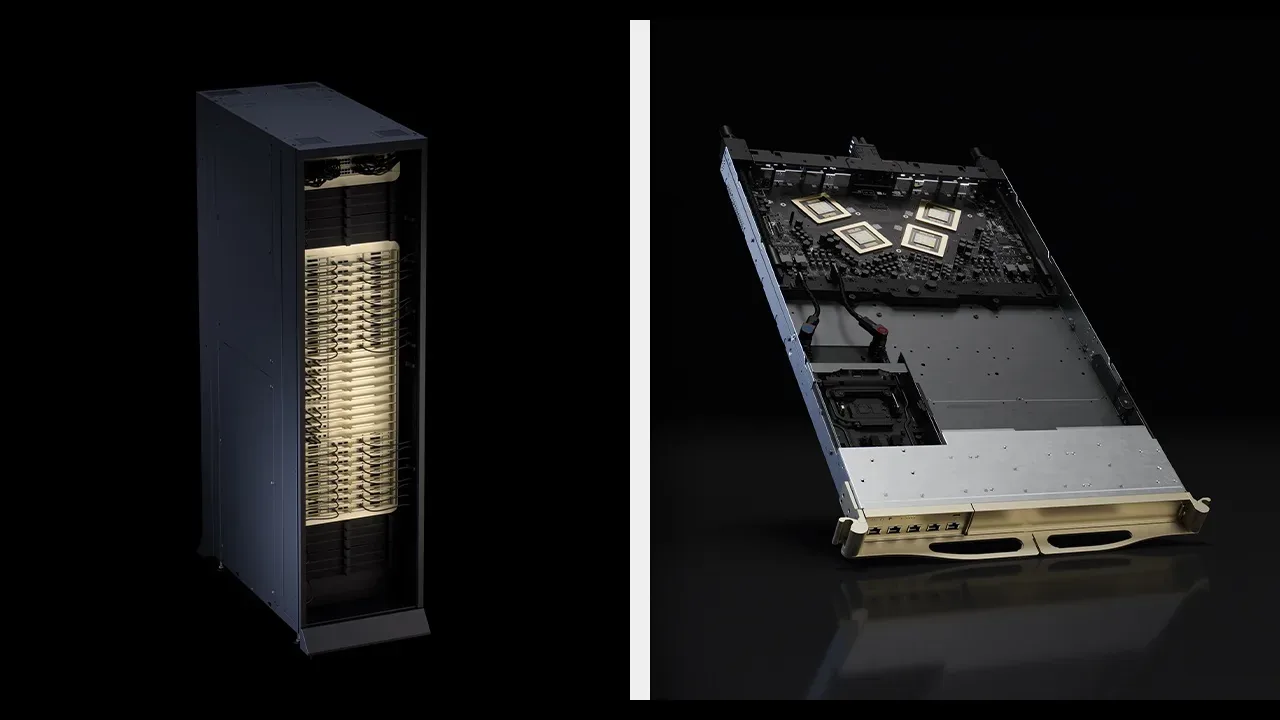
NVIDIA published specifications for its sixth-generation NVLink interconnect, the scale-up fabric for the Vera Rubin NVL72 platform. The company positions NVLink as the purpose-built network for AI factories, where GPUs operate as a single compute unit. The announcement includes performance numbers, resiliency features, and a comparison against off-the-shelf Ethernet alternatives.
Performance and topology
Sixth-generation NVLink delivers 3.6 TB/s per GPU of bidirectional bandwidth and 260 TB/s of rack-level bandwidth in a 72-GPU Vera Rubin NVL72 domain. NVIDIA claims end-to-end latency for GPU-to-GPU transfers is 3 times lower than solutions based on off-the-shelf Ethernet, with a 10 times higher packet rate. The fabric provides 130 TFLOPS of in-network compute for collective operations such as all-reduce, reduce, and broadcast.
The physical layout uses NVLink switch trays and a spine of 5,000 cables to create a single all-to-all topology. Each tray contains four NVLink 6 switch chips, offering 28.8 TB/s of total tray bandwidth and 14.4 TFLOPS of FP8 in-network compute. The roadmap includes support for scale-up domains up to 1,152 GPUs and connectivity through co-packaged optics.
NVIDIA also described NVLink-C2C, which extends the fabric to CPUs with 1.8 TB/s of coherent bandwidth between Vera CPUs and GPUs, and NVLink Fusion, which allows custom XPUs to integrate with the NVIDIA AI infrastructure platform.
Factory-level economics
The company argues that scale-up networking determines AI factory economics, particularly for mixture-of-experts (MoE) models. Efficient inference uses expert parallelism to distribute experts across GPUs, creating intensive all-to-all communication. If the fabric has low bandwidth or high latency, gains from expert parallelism can be erased by communication overhead.
NVIDIA demonstrated the impact in simulations for models such as DeepSeek-R1 and Qwen 235B, as well as a simulated 2 trillion parameter LLM. The company reports up to 2.3 times higher decode throughput compared to leading off-the-shelf Ethernet, both in a 72-accelerator scale-up domain at 3.6 TB/s per accelerator. These results are based on simulation, not measured production data.
Resiliency and maturity
NVIDIA emphasizes three metrics for evaluating scale-up solutions: delivered performance, factory resiliency, and platform maturity. Resiliency features include control plane resilience, hot-swappable switch trays, dynamic traffic rerouting, and in-service software updates. These are designed to keep AI factories operational during component maintenance or failures.
The company notes that NVLink has nearly a decade of production deployments across millions of chips, with an annual platform cadence. The software stack includes NVIDIA Dynamo, TensorRT-LLM, NIXL, and NCCL, all built on CUDA. NVIDIA describes the development process as extreme co-design, where chips, systems, fabric, and software are optimized together.
For inference engineers, the key takeaway is that delivered performance depends on more than headline bandwidth. End-to-end latency from GPU HBM through the fabric to another GPU's HBM, in-network compute for reductions, and integrated software all affect tokens per watt, per dollar, and per factory square foot. The comparison against off-the-shelf Ethernet suggests that operators deploying MoE models should evaluate scale-up fabrics on factory-level throughput, not just link rates.
Sources & references
NVIDIA: NVIDIA NVLink: The Scale-Up Network for AI Factories ↗Source consulted: 2026-10-15


