NVIDIA
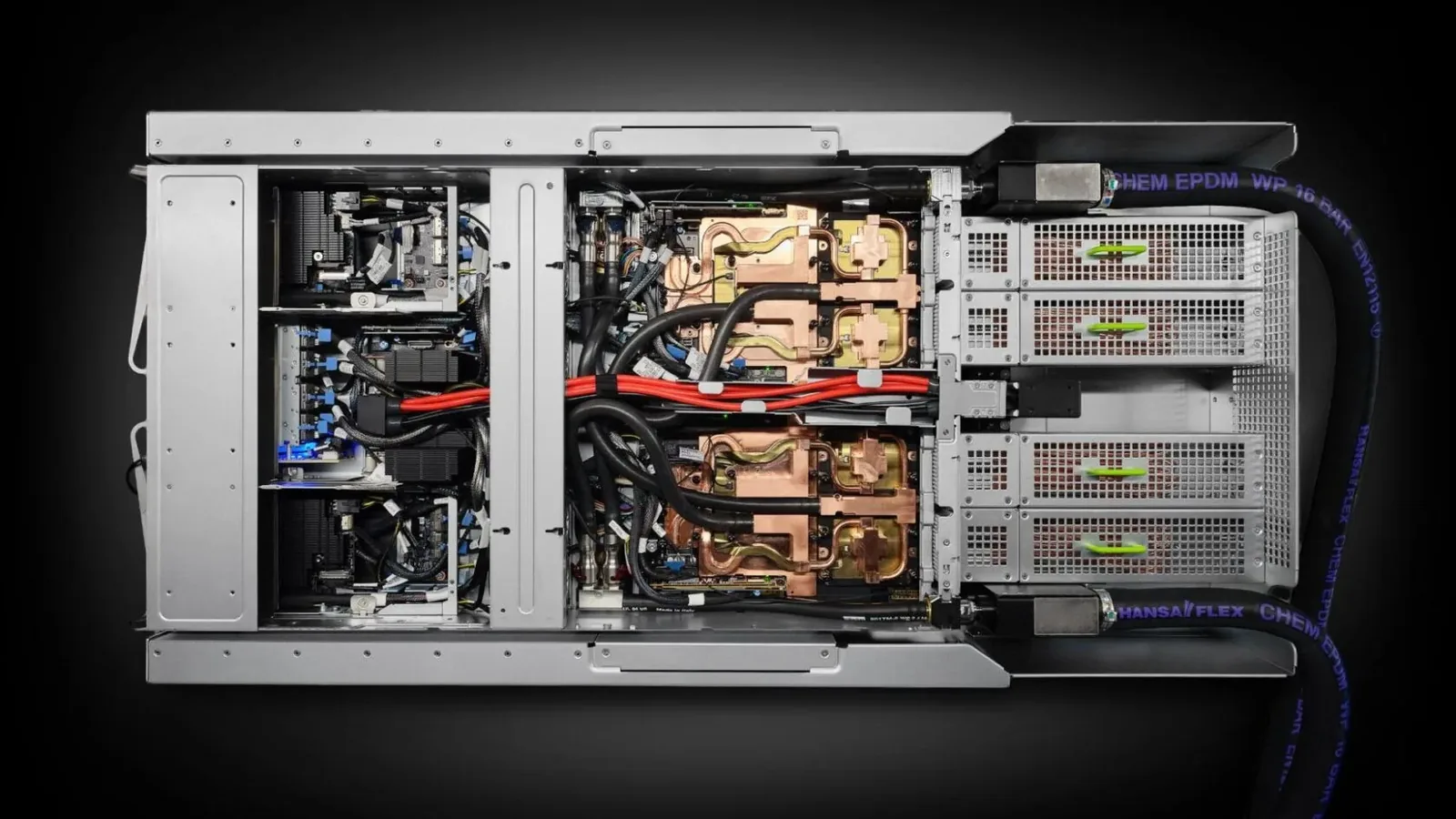
NVIDIA's Seattle Robotics Lab and Isaac engineering team published details on teaching robots to assemble GB300 tester trays, focusing on busbar assembly and multi-connector insertion. The work, described in an NVIDIA blog post, highlights where classical modular robotics outperformed end-to-end learning for these tasks.
The busbar assembly task involves grasping a metallic busbar, inserting it into a tray, driving 16 screws, and removing fixtures. The team set a target of 99.5% success and a cycle time of no more than 124 seconds, based on requirements from NVIDIA Operations and Foxconn. Their classical pipeline, using FoundationPose for perception, waypoint planning with Lissajous-curve primitives, and a high-performance impedance controller, achieved over 95% success with a 160-second cycle time. Remaining failures came from grasping errors and in-hand slippage during insertion. Screwdriving was the bottleneck, exceeding the cycle time target.
Modular stack beats end-to-end learning
The team initially expected to pivot from classical methods to end-to-end learning, but the modular pipeline proved effective. Perception used FoundationPose with multi-view estimation to mitigate 90 or 180 degree pose errors. Planning used fast waypoint planning and Lissajous-curve manipulation primitives for alignment. Control used an impedance controller with automatic damping design and inertial compensation, which the team notes is underutilized in robot learning.
For multi-connector insertion, the team faced greater uncertainty due to deformable cables and tight clearances. Cable grasping succeeded with SAM3 segmentation, but connector grasping required a new specialist pose-estimation framework called Deep Object Pose Estimation Revisited (DOPER), trained on synthetic and real-world data. Custom 3D-printed gripper fingers mechanically constrained part motion during contact, improving grasp repeatability without tactile sensors.
Connector insertion policies were pretrained in NVIDIA Isaac Lab using sim-to-real reinforcement learning, then refined with real-world residual policy training via the SPARR method, using force-torque inputs. This hybrid approach combined simulation efficiency with real-world adaptation.
Infrastructure as a force multiplier
The team emphasized the role of robotics services and the Task and Agent Lifecycle Orchestration System (TALOS). These provide reusable, containerized perception, planning, and control components, packaged as Docker containers with FastAPI/HTTP endpoints. This infrastructure accelerated development and deployment across robot platforms, avoiding dependency issues common in robotics research.
NVIDIA's post serves as a case study for engineering teams solving real-world manipulation problems, showing that classical methods can be competitive when optimized for performance, and that infrastructure matters as much as algorithms. For edge AI developers, the work illustrates the value of modular, containerized components in physical AI systems.
Sources & references
NVIDIA: The Machines that Make the Machines ↗Source consulted: 2026-10-14
 Apple